
FLOW
Sam & Scott review


Sam
There is a 90s stop-motion tv show for kids called Old Bear. Based on the books by Jane Hissey, it follows the adventures of a group of sentient toys in their playroom. We hear about the toys’ thoughts and feelings from the narrator (Anton Rodgers) and, as is often the case with tv created for young children, each episode seeks to teach us something about the world or each other, often through presenting a problem and finding a solution.
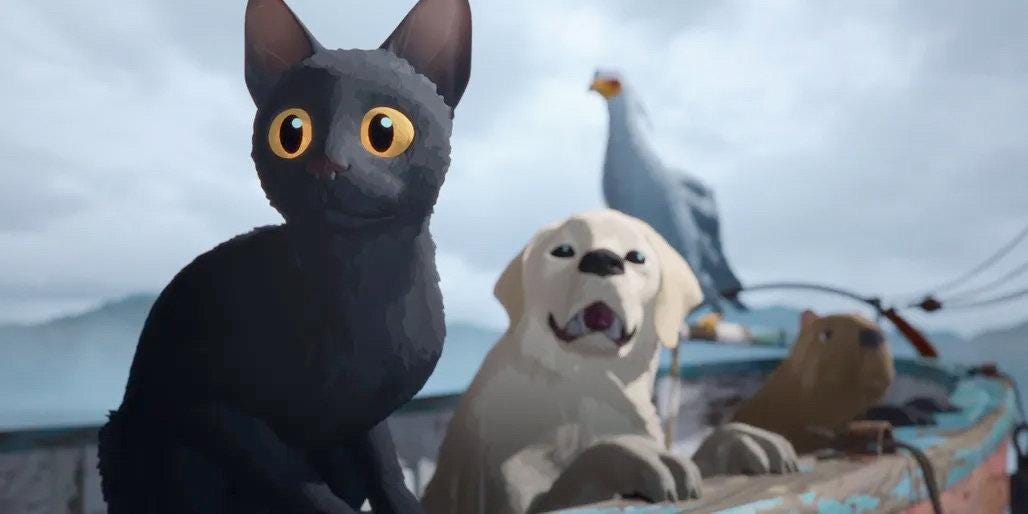
It was Old Bear that came to my mind after watching Flow. The Latvian film follows a cat as a biblical flood covers many of the remaining structures left in a seemingly post-human world. After being carried away by the rushing waters the unnamed cat ends up in a boat with a very tired capybara, an excitable Labrador, a serious secretary bird, and an obsessive lemur. As they persevere in the face of climate catastrophe they form relationships, make decisions, and learn from each other.
There is no dialogue and, unlike Old Bear, no narrator explains the situation or puts words in the mouths of the voiceless animals (although we are given real meows provided by Miut, the cat of the sound designer) so we are left to decipher the situation and their motivations for ourselves.
With climate change on everybody’s mind (except the people who can really make a difference to it) it is easy to see Flow as a warning. A lesson in what is coming for us if we do not change our ways.
But I saw it mostly not for the problem it presented but the solution. It is the same solution that every episode of Old Bear tries to teach: we will only really start to make a difference when we look towards each other.
Despite hostilities, annoyances, and falling out it’s only when our cat, capybara, lemur, bird, and dog work together that the floods begin to subside. In the face of emergency - rain leaking in through the roof of Old Bear’s playroom and threatening to ruin a dolls house, a rush of water carrying you away, a boat stranded - it’s the community around you that changes your fate.
Rating: 5/5
Scott
There’s no explanation for the apocalyptic flood that brings rising tides to the world of Flow. Humans are nowhere to be seen. Instead, we follow animals, and they act like animals too. Our protagonist, a dark grey cat, pounces at a dangling lemur’s tail like it’s a toy and chases a reflected beam of light with real frenzy. It coughs up a hairball.
The cat’s land is slowly submerged beneath the sea. The waves lap gently against new shorelines. There’s a disconcerting quietness to mother nature’s destruction, peacefully drowning the habitats of earth’s creatures.
A stray sailboat is a passing haven, and the cat is joined on board by a capybara, lemur, secretary bird, and a Labrador. A rudimentary rudder guides them towards massive, imposing spires in the distance. The animals travel a great distance and share no common language, but they are bonded by their survival instincts. Food and resources are divvied up. When the lemur loses one of his prized possessions, they work together to try and get it back. They show each other humanity - presumably more than the absent humans showed one another.
Everything that happens in Flow is out of the cat’s control: the flood that upends life for almost every living thing; the whale that saves it from drowning after diving too deep for food. It is homeless and solitary, but never hopeless. The same can be said for its crew mates, separated from their flocks and packs. Only together do they continue on towards the possibility of a new home, for apart they would surely never have made it this far.
We are all one climate catastrophe away from becoming refugees. In Flow, the humans didn’t make it. We could learn something from the animals.
Rating: 4/5
Overall
Rating: 9/10